**
INGLÉS
**
Hello traveler friends I wish you an excellent day, this time I share with you my visit to the city of Pariaguán in the state of Anzoátegui, eastern region of Venezuela, these days have been rainy, so my trips to the center of the city to do various errands, are on pause and I have used the time to organize my portfolio of photos, when I see several of them I feel nostalgia and sadness, because I remember my dear friend with whom I traveled through some cities of the country, we were in our time of university studies and there was no schedule and date to travel, one of the many trips we made was to the town of Pariaguán, which turned out to be very funny and with many stories ha, ha.
To get to this beautiful city of agricultural vocation and extractive mining activities in the company of my friend, we went to the terminal of Puerto la Cruz and took a transport to El Tigre, the approximate travel time is 2 hours and a half, already in El Tigre we did several errands and after walking along one of the main avenues we arrived at the terminal in search of the transport that would take us to our destination, While we were going along the road, I remembered a book I had read the previous semester "Office number 1", which talks about the town of El Tigre, which has an important history, since its origin goes back to the beginnings of oil exploitation in Venezuela, according to the author the first office of the oil companies was installed in the aforementioned city, hence the name of the book.
As I looked out at the landscape and the wide road, I imagined how the city was organized and built with a new economic activity for its inhabitants, who performed agricultural labor inherited from their ancestors. Mining was uncommon for them, and perhaps it wasn't easy to adapt to it. Absorbed in my thoughts, I barely realized when we were entering Pariaguán.
**
ESPAÑOL
**
Hola amigos viajeros les deseo un excelente día, en esta oportunidad les comparto mi visita a la ciudad de Pariaguán en el estado Anzoátegui, región oriental de Venezuela, estos días han estado lluviosos, por lo que mis salidas al centro de la ciudad para hacer diversas diligencias, están en pausa y he aprovechado el tiempo para organizar mi portafolio de fotos, al ver varias de ellas siento nostalgia y tristeza, porque recuerdo a mi querida amiga con la que viajé por algunas ciudades del país, estábamos en nuestra época de estudios universitarios y no había horario y fecha para viajar, uno de los tantos viajes que hicimos fue al pueblo de Pariaguán, el cual resultó ser muy divertido y con muchas historias ja, ja.
Para llegar a esta hermosa ciudad de vocación agrícola y actividades minero extractivas en compañía de mi amiga, nos dirigimos al terminal de Puerto la Cruz y tomamos un transporte hasta el Tigre, el tiempo aproximado del recorrido es de 2 horas y media, ya en el Tigre hicimos varias diligencias y luego de caminar por una de las principales avenidas llegamos al terminal, en busca del transporte que nos llevaría a nuestro destino, la población de Pariaguán, mientras avanzábamos por la carretera, recordé un libro que había leído el semestre anterior "Oficina número 1", que habla sobre población de el Tigre, la cual tiene una importante historia, pues su origen se remonta a los inicios de la explotación petrolera en Venezuela, según el autor la primera oficina de las empresas petroleras se instaló en la mencionada ciudad, de allí el nombre del libro.
Mientras observaba el paisaje y la amplia caretera, imaginaba como fue organizada y construida la ciudad con una actividad económica nueva para los habitantes, quienes realizaban labores agrícolas heredadas de sus ancestros, la minería no era común para ellos y tal vez no fue fácil adaptarse a ella, absorta en mis pensamientos apenas pude darme cuenta cuando entrábamos a Pariaguán.


---
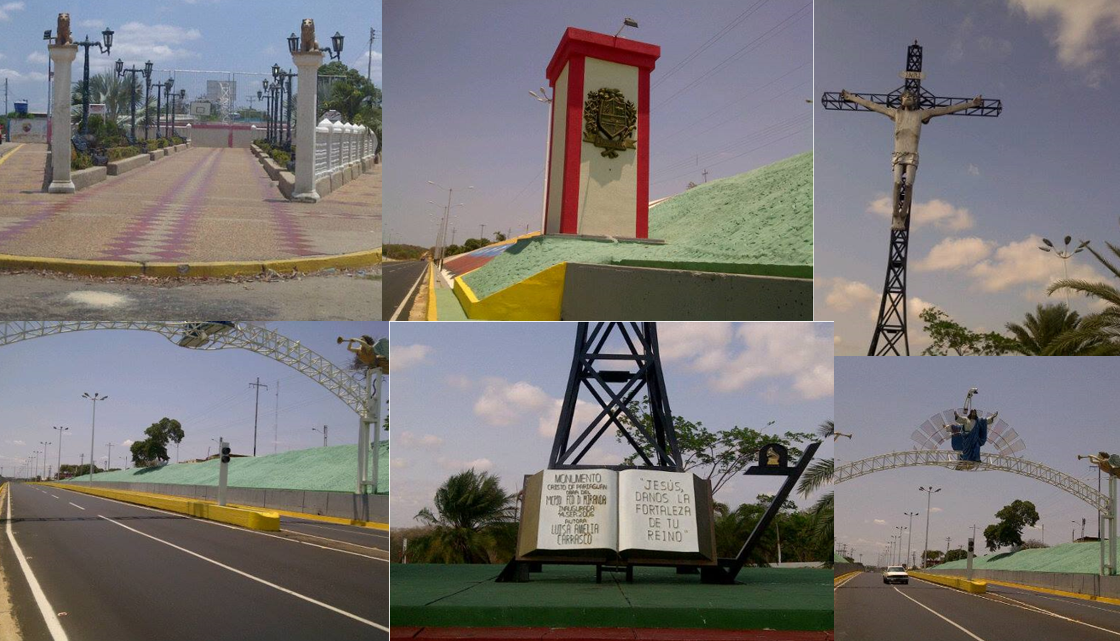
Already in Pariaguán, we started our tour through one of the avenues that caught my attention, it is called Cristo de Pariaguán avenue and in it there is a park with the sculpture of the Christ of Pariaguán, it is resting on a black iron cross, The Christ is located at the top and at the base of the tower there is a book with the name of the monument and its author Luisa Amelia Carrasco, around the sculpture there are palms and ornamental plants, the floor is concrete and is painted red and green, at the bottom of the sculpture you can see the lamps that illuminate the place.
At the end of the tour of the park Cristo de Pariaguán and talk to some locals, they explained to us that the name of the city is due to an indigenous chief of the same name, then we went to other avenues and we could know the Bolivar Square and the park Antonio José de Sucre, Bolivar Square is emblematic in Venezuela and is located in different cities, as it pays tribute to the Liberator Simon Bolivar, who fought for the independence of Venezuela and several Latin American countries, the square has benches, the sculpture of the Liberator in the center, palm trees and trees around, in most of the cities I have visited, the sculpture shows the Liberator mounted on his horse, like the Bolivar Square in Cumana, Simon Bolivar is standing with sword in hand, the square also has a perimeter fence of black bars, is an important meeting point where the locals sit to talk and share.
We also visited the Antonio José de Sucre park, a beautiful architectural work that stands out for its columns and walkways, at the entrance there are two main columns in which two sculptures of golden lions are located, then the lamps and smaller columns next to the previous ones, the view of this park is beautiful and at night hours it is very well seen, the floor is concrete and has red zigzag stripes in the center and next to each column, the park like the Bolivar square also pays homage to the hero Antonio José de Sucre, born in Cumaná.
Ya en pariaguán, iniciamos nuestro recorrido por una de las avenidas que llamó mi atención, se llama avenida Cristo de Pariaguán y en ella se encuentra un parque con la escultura del Cristo de Pariaguán, está reposa en una cruz de hierro de color negro, el Cristo se ubica en la parte superior y en la base de la Torre se encuentra un libro con el nombre del monumento y su autora Luisa Amelia Carrasco, alrededor de la escultura hay palmas y plantas ornamentales, el piso es de concreto y está pintado de color rojo y verde, al fondo de la escultura se ven las lámparas que iluminan el lugar.
Al terminar el recorrido por el parque Cristo de Pariaguán y conversar con algunos lugareños, nos explicaron que el nombre de la ciudad se debe a un cacique indígena de nombre homónimo, luego nos dirigimos hacia otras avenidas y pudimos conocer la plaza Bolívar y el parque Antonio José de Sucre, la plaza Bolívar es emblemática en Venezuela y se encuentra en las diferentes ciudades, pues rinde homenaje al Libertador Simón Bolívar, quien luchó por la independencia de Venezuela y varios países de América Latina, la plaza cuenta con bancos, la escultura del Libertador en el centro, palmeras y árboles alrededor, en la mayoría de las ciudades que he visitado, la escultura muestra al Libertador montado en su caballo, al igual que la plaza Bolívar de Cumaná, Simón Bolívar se encuentra de pie con la espada en mano, la plaza cuenta además con cerca perimetral de rejas negras, constituye un importante punto de encuentro donde los lugareños se sientan a conversar y compartir.
También visitamos el parque Antonio José de Sucre, una hermosa obra arquitectónica que destaca por sus columnas y camineríaS, en la entrada hay dos columnas principales en las cuales se ubican dos esculturas de leones dorado, luego las lámparas y columnas más pequeñas al lado de las anteriores, la vista de este parque es hermosa y en horas nocturnas se ve muy bien el piso es de concreto y tiene franjas rojas en forma de zigzag en el centro y al lado de cada columna, el parque al igual que la plaza Bolívar rinde también homenaje al prócer Antonio José de Sucre, nacido en Cumaná.


Pariaguán, is located on the well-known Guanipa table, a small elevation of the relief, it is also the gateway to the plains region, through the Guárico state, in fact from this city you can easily head to Santa María Ipire, a beautiful plains town in the heart of Venezuela, as we were not in a hurry we took advantage and made a quick trip to the Guárico state, to learn a little about the city where the singer and composer of Creole music Reynaldo Armas was born, it is a beautiful plains area, with beautiful landscapes, also in it is the Banco Obrero dam, in this town one of our eventful stories began hehe, due to the rush to get off the transport, my friend left the backpack where we carried food and water, when we arrived at the square which is very pretty by the way, we realized that the backpack was missing, we quickly went to a place in the square where there were several people, we asked for the bus stop and explained the characteristics of the bus we were traveling on, At that moment, the driver who was looking for us to give us the bag appeared. We thanked him and invited him to eat. Then we waited for his turn to leave and he took us back to Pariaguán.
Visiting the town of Pariaguán and part of the state of Guárico was a nice adventure, as I was able to see several of its sculptures, including those of the angels located in the entrance arch, this is white, next to it you can see the green walls and a column with a golden shield, on our tour I also saw several establishments, hotels and the José Antonio Anzoátegui University
Pariaguán, se ubica en la conocida mesa de guanipa, una pequeña elevación del relieve, es además la puerta de entrada a la región llanera, por el estado Guárico, de hecho desde esta ciudad te puedes dirigir cómodamente hasta Santa María Ipire, un hermoso pueblo llanero en el corazón de Venezuela, como no teníamos prisa aprovechamos e hicimos un rápido viaje al estado Guárico, para conocer un poco sobre la ciudad donde nació el cantante y compositor de música criolla Reynaldo Armas, es una linda zona llanera, con bellos paisajes, además en ella se encuentra la represa banco obrero, en esta población comenzó una de nuestras acidentadas historias je, je, por la premura al bajar del transporte, mi amiga dejó el morral donde llevamos la comida y el agua, cuando llegamos a la plaza que es muy bonita por cierto, nos dimos cuenta que faltaba el morral, rápidamente nos dirigimos hasta un lugar de la plaza donde habían varias personas, preguntamos por la parada de buses y explicamos las caraterísticas del bus donde viajamos, en ese momento apareció el chofer quien nos estaba buscando para entregarnos el bolso, le agradecimos y lo invitamos a comer, luego esperamos su turno de salida y nos llevó de vuelta a Pariaguán.
Visitar la población de Pariaguán y parte del estado Guárico, fue una linda aventura, pues pude conocer varias de sus esculturas, entre ellas las de los ángeles ubicados en el arco de entrada, este es de color blanco, al lado se observan los muros verdes y una columna con un escudo dorado, en nuestro recorrido vi también varios establecimientos, hoteles y la universidad José Antonio Anzoátegui

---


---
¡Bendiciones!
Blessings!
[//]:# (!worldmappin 8.82347 lat -64.75960 long d3scr)

---
---
Translated with https://www.deepl.com/translator
All images are my own.
Todas las imágenes son de mi autoría.
#travel
#neoxian
#spanish
#worldmappin
#architecture
#photography
#lifestyle
#ecency
#hive-163772
Payout: 0.000 HBD
Votes: 339
More interactions (upvote, reblog, reply) coming soon.